
Evaluating Injuries at the Olympics Through Imaging
Radiology's key role in keeping athletes healthy during the international games

As the world turns its attention to the 2026 Olympic Games, elite athletes are once again pushing the limits of speed, strength and endurance. This RSNA News story revisits the essential role radiology plays in diagnosing injuries, guiding care and supporting athletes across some of the world's most demanding sports.
Most sports radiologists are familiar with the typical weekend warrior injuries that occur during late-night hockey league games, 16-inch softball playoffs or parents vs. kids' soccer matches. It’s a rare few who have to learn about injuries that occur in more obscure sports, such as luge, super giant slalom or skeleton.
When he was named director of medical imaging during the Vancouver 2010 Olympic and Paralympic Winter Games, that is just what Bruce B. Forster MSc, MD, FRCPC, had to do.
“Preparing for the Olympics requires learning about specific types of injuries that occur in very specific sports,” said Dr. Forster, who is a professor in the Department of Radiology at University of British Columbia Faculty of Medicine in Vancouver, Canada.
For each Olympic Games, the International Olympic Committee (IOC) seeks volunteer radiologists from the host city. Dr. Forster’s mentor, Jack Taunton, MD, a leader in the development of clinical sports medicine in Canada, was named chief medical officer for the Vancouver Games and invited him to join the team.
To prepare, Dr. Forster attended the 2008 Beijing Summer Games as an observer to get a sense of what imaging needs arise during the Olympics and what a typical day looks like for the onsite medical personnel.
He also studied the Torino 2006 Olympics to get an idea of the type of injuries and imaging needs that are more specific to a winter competition. For the next two years, he worked with the Vancouver-based imaging team to plan for 2010.

Olympics Imaging Operations
Dr. Forster led a volunteer team of 19 radiologists and 51 technologists, which included three imaging assistant supervisors and an imaging assistant technical lead for onsite US.
In the Polyclinic, which is a one-stop shop for all the athletes, Dr. Forster and his team worked two shifts daily, broken up within the hours of 8 a.m. to 11 p.m. Imaging equipment at the Polyclinic included one 1.5T MRI, two US units, one multi-slice CT and one X-ray unit. For the first time at the Olympics, portable US was made available at five venues to bring imaging directly to the athletes.
The different sports competing by season lead to different equipment requirements. For example, CT has historically been used more commonly during the Winter Games than in summer due to an increased incidence of multi-trauma, according to Dr. Forster. Therefore, it is more practical during the Summer Games to refer an athlete to the local hospital when a CT is needed.
While the Winter Games have only one-third as many athletes as the Summer Games, the injuries that occur in winter are more frequent and severe, he explained.
“During the Olympic Games, only 6% of injured athletes require imaging,” Dr. Forster said. “That seems like a small percentage, but during the Winter Games, it will equate to 800 to 900 imaging studies. For the Summer Games, that number goes up to 1,000.”
Dr. Forster and his team provided imaging for one serious injury in Vancouver. In the women’s sprint cross-country skiing event, Slovenian athlete Petra Madjič fell during the preliminaries, fracturing a few ribs. Her imaging was inconclusive, and she continued competing, ultimately earning a bronze medal—the first individual Winter Olympic medal for Slovenia in 16 years. She attended the awards ceremony with a tube in her chest to relieve the pneumothorax that had subsequently developed.
“These are the types of ‘against all odds’ stories that the Olympics are all about, and they are very inspiring,” Dr. Forster commented.
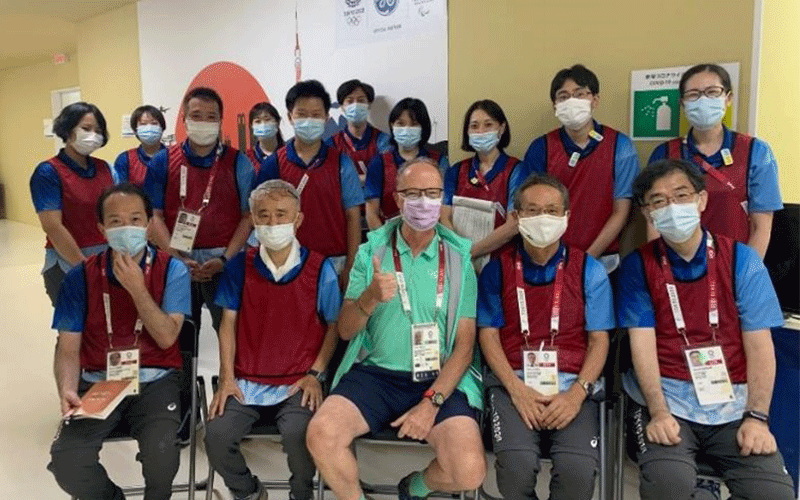
Continuing To Provide Olympic Imaging Support
For the 2024 Summer Games in Paris, Dr. Forster served on the IOC Medical and Scientific Games Group as the first radiologist to join the team. The team included a wide variety of health care professionals, ranging from dentists and public health experts to pharmacists and physiotherapists.
“The IOC Medical and Scientific Games Group is responsible for the health of all athletes during the games and provides quality assurance and improvement for all medical services,” Dr. Forster said. “The team assists in injury and drug surveillance and supports overall athlete care.”
As part of his role, Dr. Forster spent a month in Paris during the 2024 Summer Games, sharing his experience with the local radiologists tapped for the Polyclinic. Thirty-three radiologists and 32 radiologic technicians, all from France, comprised the team scheduled to support the athletes.
Dr. Forster worked with the radiology team to address imaging issues, providing injury surveillance and venue medical inspection. He also had a chance to watch some events.
“I have been honored to witness some amazing competitions during the Olympics, including the Canadian women’s soccer team winning gold at Toyko 2020, which actually took place in the summer of 2021, and the Canadian women’s ice hockey team winning gold in Beijing in 2022,” Dr. Forster commented. “At the summer Olympics, I enjoyed the diverse events of track and field, rock climbing and skateboarding, which were new events in Tokyo.”
For radiologists who are interested in being a part of larger sporting events and who might live in future Olympic host cities, Dr. Forster recommends starting by volunteering locally.
“Radiologists should put themselves amidst local and regional sporting events, caring for athletes of all levels,” he said. “Radiologists play a key role in the care of athletes, helping to identify injuries and monitor progress and recovery, so that athletes of all levels can return to play as soon as possible.”
At the 2026 Milan Cortina Winter Games, imaging remains central to athlete care. In a high-profile example, 41-year-old U.S. alpine skier Lindsey Vonn announced she still plans to compete in women's downhill despite a completely ruptured anterior cruciate ligament and associated bone bruising and meniscal damage sustained in a World Cup crash.
Ongoing medical evaluations illustrate how clinical imaging and multidisciplinary care play a role in real-time decisions about athlete health and competition readiness.
For More Information
Read previous RSNA News articles on sports imaging: