
RadLex Radiology Lexicon
RadLex provides the foundation for vital data resources used in radiology:
- The LOINC/RSNA Radiology Playbook
- RadLex Playbook Protocols
- RadLex Playbook Series
- RadReport Radiology Reporting Templates
- RadElement Common Data Elements
The development of RadLex has been supported by the National Institute of Biomedical Imaging and Bioengineering (NIBIB) and the cancer Biomedical Informatics Grid (caBIG) project.
RadLex is licensed freely for commercial and non-commercial users. Review and download the license.
RadLex is now available on GitHub, providing a transparent, collaborative platform for accessing and managing the RSNA radiology ontology. By leveraging GitHub, users can easily explore updates, track changes, submit feedback, and contribute to the ongoing development of this comprehensive radiology terminology resource. Review RadLex on GitHub.
RadLex has been released in a HL7 FHIR format designed to make it easier to incorporate systems and electronic patient records. This FHIR version allows Radlex to be a terminology binding for other FHIR resources, such as observations, using the standard FHIR format enabling coded values. Review RadLex FHIR information.
Have a suggestion? We welcome your input to improve RadLex! Use this form to enter your recommended changes or suggestions for new terms. Or visit the RadLex GitHub and add your request.
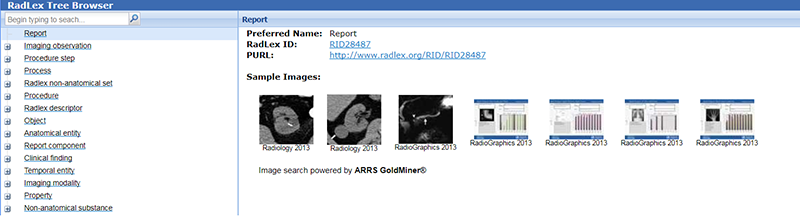
Standardized Exam Names: LOINC/RSNA Radiology Playbook
The wide variation in the way radiology procedures are named in radiology departments makes ordering and protocoling less efficient and radiology records difficult to aggregate or compare across sites. The LOINC/RSNA Radiology Playbook was created to address this critical problem. Building on RadLex, RSNA developed names for nearly 1,000 commonly performed radiology procedures. Playbook provides a standard system for naming radiology procedures, based on the elements that define an imaging exam such as modality and body part. By providing standard names and codes for radiologic studies, Playbook supports operational and quality improvement efforts, including workflow optimization, chargemaster management, radiation dose tracking, enterprise integration and image exchange.
The need
Today radiology facilities generally make up their own codes and names for radiology exams. The LOINC-RSNA Radiology Playbook offers an agreed set of names for radiology procedures to enhance information sharing and data analysis.
Features and benefits
Each Playbook exam name includes a unique numerical code (LOINC-RSNA Radiology Playbook Identifier) and a set of procedure names of varying length and readability for use in different applications. The Playbook can support your practice by:
- Promoting interoperability of imaging exams
- Facilitating quality improvement, outcomes research and data analysis
- Enabling integration of radiology with enterprise systems
- Simplifying participation in data registries
- Offering optimization to workflow, billing management and radiation dose tracking
- LOINC/RSNA Radiology Playbook
- Please note: You'll need to create a free login to access the LOINC/RSNA Radiology Playbook. Once logged in, navigate to "loinc.org/search" and enter "class:rad" to search the playbook.
- Download the LOINC/RSNA Radiology Playbook (2025-10-03)
Standardizing Acquisition Protocol Names: RadLex Protocol Playbook
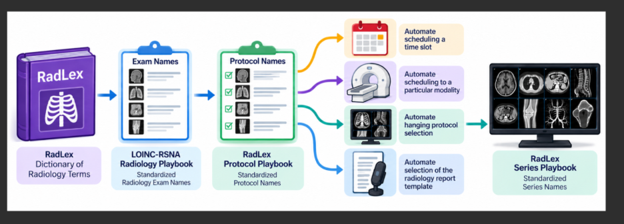
Since 2018, we have had standard radiology exam names in the form of the LOINC-RSNA Radiology Playbook. This standard set of names and codes have lived in the back end of EMRs and image exchange systems. However, as our field became more complex, exam names were no longer enough to communicate the detailed information about each exam. This information tends to be captured in the Acquisition Protocol.
Each acquisition protocol is typically created to answer either a specific clinical question or investigate a particular focus of anatomy for pathology. Which protocol is used in acquisition will then influence which hanging protocol is used within the PACS to view the images, and which reporting template is used to dictate the findings. Unfortunately, between 2018 and now, this protocol information has not been handed off to downstream system for automation. Thus, organizations have tried to solve this problem by creating protocol specific exam names (orderables), which leads to exam name bloat.
Through discussion with EMR vendors, modality vendors, PACS vendors and reporting platforms, this needed workflfow is being constructed to allow EMRs to formally model the protocol information and hand it off to downstream systems, which opens the door for setting up automation, and real-time savings across the radiology lifecycle.
While the first step is to lay the technical workflow foundation and hand off the protocol information institutions are using today, the end goal is to create a group of standardized protocol names/elements for EMRs to hand off to downstream systems to make the process organization and vendor neutral and enabling full interoperability.
RadLex, in collaboration with SNOMED CT, is in the process of collecting protocol naming information across organizations and countries to identify patterns in the elements captured in exam names and protocol names. They will then work to create clinical buckets of protocol names to hand off standard protocol information using the system infrastructure that exists today, and to partner with RISes to develop a way to model the data in the future so that the elements from the exam name and protocol name can all be captured and handed off as a continuation of detail regarding the same event. Join the SNOMED CT workgroup.
We are looking for a breadth of protocol names from all types of organizations. If you would like to contribute your protocol names, please add them.
RadLex Playbook Series
The RadLex Playbook Series establishes standardized, vendor-neutral names for imaging series, helping streamline radiology workflows and improve imaging data analysis. Visit the RadLex Playbook Series page to test our interactive tool and learn more about how standardized imaging series naming can improve consistency across radiology.
FAQs
Please email radlex-feedback@lists.rsna.org with any comments or questions.
RadLex Committee members:
Audrey R. Verde, MD, PhD, Chair
Michael Hood, MD, Vice Chair
Mariam S. Aboian, MD, PhD
Tarik Alkasab, MD, PhD
William Auffermann, MD, PhD
Leonid Chepelev, MD, PhD
Beverly Collins, PhD
Ethan Cohen, MD
Jessica G. Fried, MD
Scott Henneman, MD
Monica L. Huang, MD
Gloria Hwang, MD
Charles E. Kahn, Jr., MD, MS
Marc Kaemmerer, MD
Geunwon Kim, MD, PhD
Jeff Lerman, PhD
Stacy D. O'Connor, MD, MPH
Nancy Pham, MD
Dogan Polat, MD
Babak Saboury, MD
Tubo Shi, MBChB
Nanda Deepa Thimmappa, MD
Ryan Tierney, MD
Kenneth C. Wang, MD, PhD
View and download LOINC components, including the Radiology Playbook under the SearchLOINC.