RSNA Press Release
Hidden Fat in Your Body Type May Put You at Greater Brain Risk

OAK BROOK, Ill. (January 27, 2026) – The effect of obesity on brain health may depend not only on how much fat is in the body, but also on the areas of the body where fat is stored, according to a study published today in Radiology, the flagship journal of the Radiological Society of North America (RSNA).
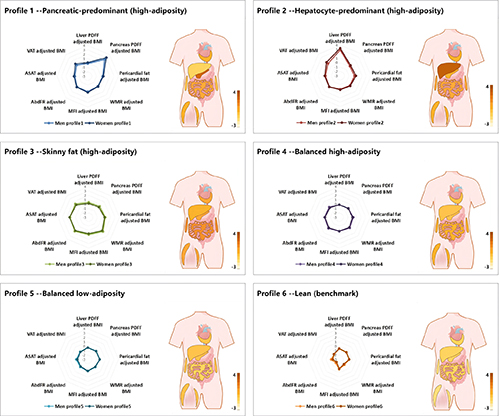
Researchers at The Affiliated Hospital of Xuzhou Medical University in Xuzhou, China described two previously unidentified fat distribution types on MRI that show the strongest associations with adverse brain and cognitive outcomes: a “pancreatic predominant” type, which shows a markedly high concentration of fat in the pancreas compared with other areas of the body, and a “skinny fat” type, which has a high fat burden despite not fitting the typical patterns of high obesity.
While previous research has established a link between obesity and brain/cognitive health, particularly in people with higher ratios of visceral fat, this new study focuses on the specific risks associated with specific fat distribution patterns, explained study coauthor Kai Liu, M.D., Ph.D., an associate professor in The Affiliated Hospital’s Department of Radiology.
“Our work leveraged MRI’s ability to quantify fat in various body compartments, especially internal organs, to create a classification system that’s data-driven instead of subjective,” Dr. Liu said. “The data-driven classification unexpectedly discovered two previously undefined fat distribution types that deserve greater attention.”
The researchers used data from 25,997 individuals in the UK Biobank database, which houses anonymized medical imaging measurements alongside volunteers’ physical measurements, demographics, disease biomarkers, medical history and answers to lifestyle questionnaires. This allowed the team to compare brain health outcomes with patterns of body fat distribution.
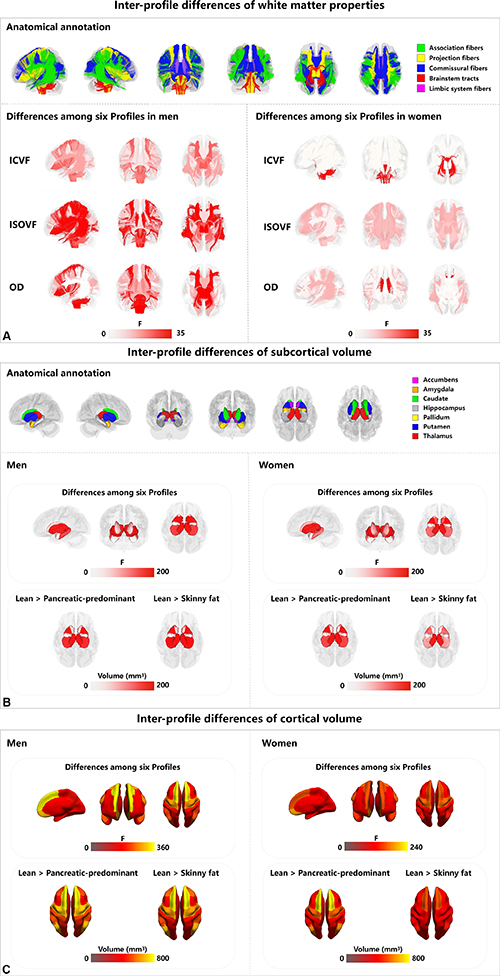
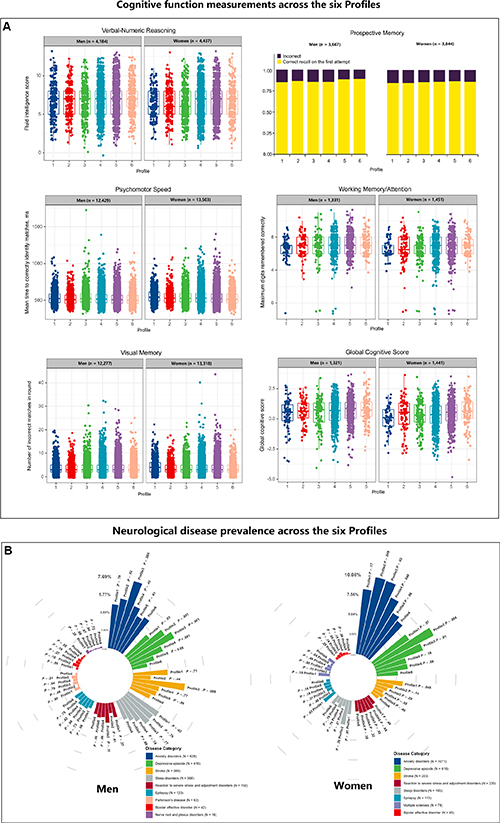
Of the body fat profiles the team identified, “pancreatic-predominant” and “skinny fat” profiles were most associated with extensive gray matter atrophy, accelerated brain aging, cognitive decline and increased risk of neurological disease. These risks were present in both men and women, with nuanced variations between the sexes.
Individuals with “pancreatic-predominant” distribution patterns showed a proton density fat fraction—an MRI marker that provides a precise estimation of fat concentration in tissue—of around 30 percent in the pancreas.
“This level is about two to three times higher than that of other fat distribution categories, and it can be up to six times higher than that of lean individuals with low overall fat,” Dr. Liu said. “Additionally, this group tends to have a higher BMI and overall body fat load.”
Interestingly, however, these individuals didn’t have significantly pronounced liver fat compared to those with other profiles. High pancreatic fat accompanied by relatively low liver fat emerges as a distinct, clinically overlooked phenotype, Dr. Liu noted.
“In our daily radiology practice, we often diagnose ‘fatty liver,’” Dr. Liu said. “But from the perspectives of brain structure, cognitive impairment and neurological disease risk, increased pancreatic fat should be recognized as a potentially higher-risk imaging phenotype than fatty liver.”
Individuals with “skinny fat” profiles show the highest fat burden in nearly all areas except the liver and pancreas. Unlike a balanced “high obesity” profile, “skinny fat” tends to be more concentrated in the abdomen.
“Most notably, this type does not fit the traditional image of a very obese person, as its actual average BMI ranks only fourth among all categories,” explained Dr. Liu. “The increase is perhaps more in fat proportion. Therefore, if one feature best summarizes this profile, I think, it would be an elevated weight-to-muscle ratio, especially in male individuals.”
In this study, the research team focused specifically on the neurological and brain cognitive risks associated with different fat distribution patterns. As for risks in other areas, such as cardiovascular or metabolic health, Dr. Liu noted that more research is needed to determine how these patterns could be related.
Understanding the risks associated with specific fat distribution patterns can help health care providers guide more personalized treatment and help patients keep their brains healthier. As Dr. Liu explained, “Brain health is not just a matter of how much fat you have, but also where it goes."“Association of Body Fat Distribution Patterns at MRI with Brain Structure, Cognition, and Neurological Diseases.” Collaborating with Dr. Liu were Miao Yu, M.D., Libin Yao, M.D., Sanjeev Shahi, M.M., Yingqianxi Xu, M.M., Meizi Li, M.M., Qingtong Zheng, M.M., Di Ma, M.M., Qi Zhang, M.M., Dan Wang, B.M., Yang Wu, B.M., Xiao Zhou, B.M., Haitao Ge, Ph.D., Chunfeng Hu, M.D., and Yanjia Deng, M.D., Ph.D.
Radiology is edited by Suhny Abbara, M.D., FACR, MSCCT, Mayo Clinic, Jacksonville, Florida, and owned and published by the Radiological Society of North America, Inc. (https://pubs.rsna.org/journal/radiology)
RSNA is an association of radiologists, radiation oncologists, medical physicists and related scientists promoting excellence in patient care and health care delivery through education, research and technologic innovation. The Society is based in Oak Brook, Illinois. (RSNA.org)
For patient-friendly information on MRI, visit RadiologyInfo.org.
Images (JPG, TIF):
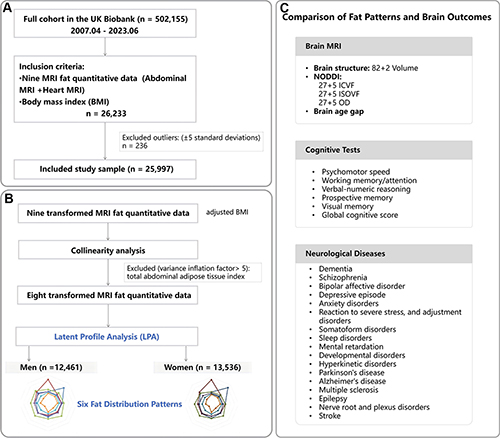
Figure 1: Participant selection and study design. (A) Flow diagram of the participant selection process in UK Biobank. (B) Nine quantitative MRI-derived adipose measurements were extracted from the UK Biobank. Following adjustment for body mass index (BMI) and collinearity analysis, eight adipose parameters were retained for latent profile analysis (LPA). Sex-specific clustering yielded six distinct fat distribution patterns in male and female participants. (C) These patterns were subsequently analyzed for associations with brain structural metrics, neurite orientation dispersion and density imaging (NODDI) parameters, brain age gap, cognitive performance measures, and neurologic diseases. ICVF = intracellular volume fraction, ISOVF = isotropic or free water volume fraction, OD = orientation dispersion index.