
How One Step Forward Can Open New Doors
A reflection on connections, experiences and unexpected paths in three RSNA members’ careers


Three RSNA members joined the Society for different reasons: access to journals, educational opportunities and professional development. What they found was much more: mentorship, leadership experience, publishing opportunities and connections that helped shape their careers.
A Rising Star Finds New Opportunities
Kevin Fung, MBBS, a consultant radiologist in the Department of Radiology at Hong Kong Children’s hospital, first joined RSNA around 2014, drawn by the coveted access to its journals. He was particularly interested in the cutting-edge research found in Radiology and the educational content featured in RadioGraphics.
“For a trainee, it’s one of the biggest benefits,” Dr. Fung emphasized. “And, it doesn’t hurt that RSNA welcomes trainees at no cost.”
Both factors were instrumental in Dr. Fung’s return to the Society after allowing his membership to lapse during COVID-19. In 2024, he began a pediatric interventional radiology fellowship, as the world emerged from the pandemic. Recalling how helpful he’d found RSNA previously, he said it was a “no-brainer” to lean back into the organization for this new training phase, albeit with more expertise under his belt.
Returning with experience and confidence didn’t diminish what RSNA could offer to Dr. Fung. If anything, he said, it enhanced the value he found in membership.
“I was encouraged to begin submitting education exhibits to RSNA’s meetings, and that nourished my interest in radiologic journalism,” Dr. Fung said. “It also helped me advance down a somewhat unplanned but fruitful path.”
Dr. Fung was thrilled when his very first poster presentation, submitted with a colleague during COVID, was selected for publication in RadioGraphics. “I eventually joined the RG Team, learning the nuances of the journal submission, peer review and selection process,” he said.
The RG Team refers to the RadioGraphics Trainee Editorial Advisory Members, a group of trainees who work with the journal’s team to help produce educational content, editorials and resources for the radiology community.
That exposure prompted Dr. Fung to apply for the RSNA International Editorial Fellowship, which he won in 2025. “It is the highlight of my membership experience to date,” he said.
Being able to interact closely with Christine Cooky Menias, MD, RadioGraphics editor, and attend staff meetings provided an experience he never anticipated. “These are opportunities that I would never have imagined in my life,” Dr. Fung admitted. “Those behind-the-scenes insights—identifying what is the strength of the manuscript, authorship issues, ethics of publishing—are not something one can learn from reading papers alone.”
Exclusive learning opportunities are one benefit Dr. Fung has found through RSNA. Another is recognition. In 2025, he was named an RSNA Rising Star, an honor reserved for accomplished members who are less than five years post-residency.
“It’s not just that you get a connection with education or different communities; you build your own career as well. You take initiative; you get into leadership. That's what I'm looking for at RSNA.”
— SHAMA JASWAL, MD

A Lifetime Learner Builds Connections
Learning opportunities through RSNA were a priority for Shama Jaswal, MD, a resident physician at New York Presbyterian, Weill Cornell Medicine. As a medical student, she was deeply committed to elevating her understanding of imaging and staying abreast of developments in the field.
Dr. Jaswal joined the Society around 2017 and as her interest in academic radiology blossomed, she found an outlet in the RSNA’s research and education activities. “One of the most impactful initiatives for me was the opportunity to be part of the RadioGraphics social media and innovation team,” said Dr. Jaswal, who helped spread education globally via social media.
“Through that initiative, I really loved how I could learn and contribute to the Society,” she said. “It was not only helpful for my clinical background and training, because I could work on my own skills, but it was also beneficial being involved actively with the community and having great mentorship with the national and international radiologists.”
According to Dr. Jaswal, that level of involvement adds another layer of education to the formal training that radiologists undergo. “You’re publishing scholarly articles, accessing more of the articles, working with colleagues and benefiting from their mentorship,” she explained. “There’s a combination of effects that you get from the organization, which is why it’s difficult to single out just one component as most valuable.”
Research has also been a significant part of Dr. Jaswal’s RSNA experience. She has published scholarly work in Radiology and RadioGraphics and, in 2025, applied for an RSNA R&E Foundation Resident/Fellow Research Grant. Although the proposal was not funded, she said the experience helped her refine research ideas and strengthened her commitment to advancing imaging and patient care.
The molecular imaging specialist expects RSNA to remain a resource as she builds her professional future and pursues new leadership opportunities. She views the Society as a global community that fosters innovation, collaboration and lifelong learning.
Based on her early career experience, she said she can’t wait to see what comes next as she evolves her career as a faculty member at the RSNA Annual Meeting.
“It’s not just that you get a connection with education or different communities; you build your own career as well,” she said. “You take initiative; you get into leadership. That's what I'm looking for at RSNA.”
With that in mind, Dr. Jaswal encouraged medical students and young radiologists not to postpone membership, even if they don’t immediately volunteer for a specific initiative.
“Most importantly, be an active learner, show your interest in volunteerism, and try to attend the annual meeting in person to build connections,” she advised. “Allow your association profile to flourish organically. If you’re showing your hard work, your dedication, your passion…you’ll get noticed.”

A Volunteer Extraordinaire Makes an Impact
Getting involved and getting noticed heavily influenced the professional path that Karen Rodriguez, MD, took. A research fellowship at the National Institutes of Health (NIH) between her third and fourth year of medical school introduced the possibilities of a career in imaging.
Dr. Rodriguez’s time under the tutelage of a radiologist at the agency stoked interest in the field, which was reinforced by a maiden trip to the RSNA annual meeting that same year. “My mentor nudged me to submit an abstract for the meeting, and it was accepted with an invitation to deliver a talk,” she recalled.
Dr. Rodriguez credits the experiences at NIH and RSNA 2014 for her radiology discovery and subsequent journey, noting the Society’s plethora of resources, even for medical students who may not have chosen radiology yet for their professional focus.
Now a board-certified diagnostic radiologist, Rodriguez emphasized that she chose the imaging field herself. By the time she started her residency, she was already sold on the value of RSNA.
During that period, she sat on the RSNA Resident and Fellows Committee. She recalls encountering multiple people, years later, who remembered her from committee activities at the conference.
“It’s really rewarding to see that you can make a difference for someone who’s thinking about going into radiology or they’re already in radiology but just getting their feet wet,” she said.
The experience on the RSNA committee served as a springboard for Dr. Rodriguez’s involvement on various other panels in the broader radiology community, including as fellowship program director for the cardiothoracic fellowship at Massachusetts General Hospital in Boston, where she works today.
Even as her volunteer work takes her to other settings, the ongoing value of RSNA membership isn’t lost on Dr. Rodriguez. “RSNA plays a critical role in keeping radiologists up to date on cutting-edge research, including AI,” she said. “On a day-to-day basis, access to RSNA journals as an educational resource offers continuous value.”
Three Careers, One Community
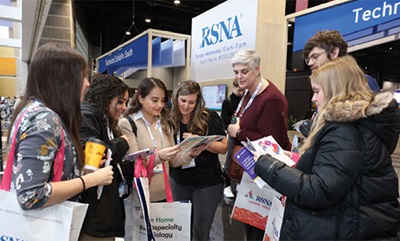
While each has leveraged different resources and opportunities, Drs. Rodriguez, Jaswal and Fung share an appreciation for the annual meeting as a place to learn, reconnect and build professional relationships.
“It’s the conference everybody wants to go to,” Dr. Rodriguez said. “I still recall my amazement at the sheer size of the event.”
While radiologists may attend other conferences within their own subspecialties, Dr. Rodriguez said the RSNA annual meeting offers something special. “It’s the one you can always count on going back to and seeing colleagues you may not see otherwise, including friends who went in a different direction after completing their residency,” she said. “I think that’s the best part of the conference—just keeping those connections.”
Dr. Jaswal agreed, emphasizing how the event reaches across not only subspecialties but also borders. “I really can’t wait every year to see colleagues from around the world,” she said. “What’s even more important is to understand what's going on between different places with regard to imaging or treatment.”
Dr. Fung described the networking and mentoring potential of the meeting as “massive” but also warmed to the camaraderie that defines not only the event but the Society as a whole. “Both are a juncture for people sharing the same passion for radiology,” he said. “There are people passionate about cutting-edge research; there are those who are passionate about the latest technology. RSNA is just so diverse. There’s something for everyone.”
For More Information
Learn more about RSNA membership now.
Read previous RSNA News stories on career development in radiology: