RSNA Press Release
AI Could Provide ‘Early Alert’ for Breast Cancer 6 Years in Advance

OAK BROOK, Ill. — Three commercially available radiology AI systems have shown the potential to flag early signs of breast cancer up to 6 years before a diagnosis, according to a study published in Radiology, the flagship journal of the Radiological Society of North America (RSNA).
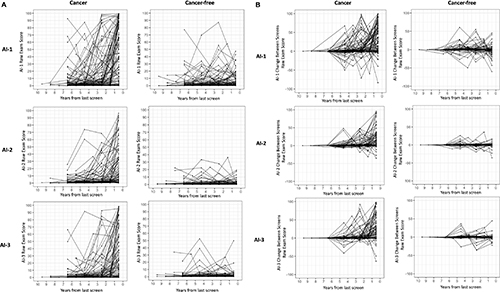
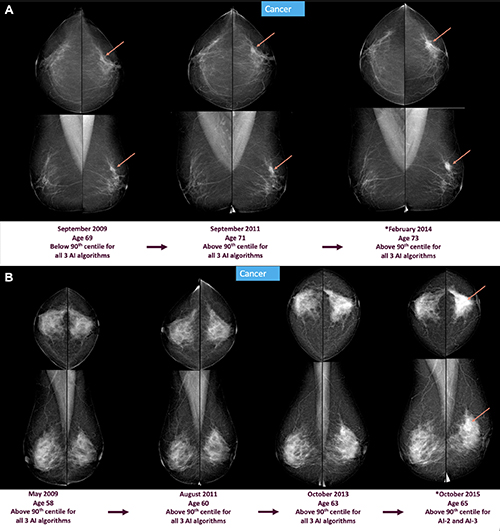
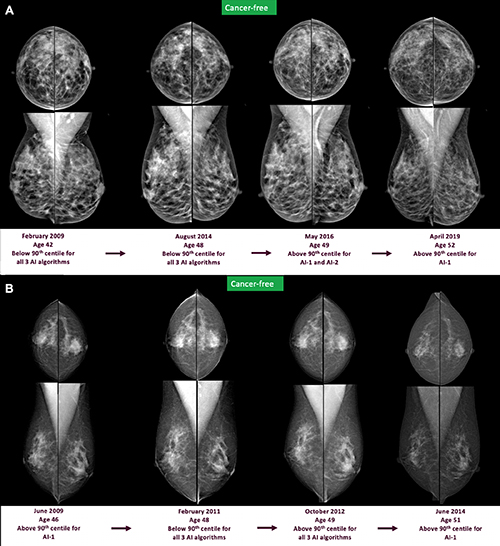
In a Swedish retrospective study, researchers tested three AI-based computer-assisted detection (AI-CAD) systems on mammogram data from a large screening population. They found that cancer prediction scores issued by AI-CAD were elevated, on average, for individuals who were eventually diagnosed with breast cancer, while scores were low for those who remained cancer-free.
“Approximately 20% of breast cancer cases demonstrate mammographic signs that are already visible to AI around 6 years before diagnosis,” explained senior coauthor Fredrik Strand, M.D., Ph.D., of Karolinska University Hospital in Stockholm. “Our study confirms the potential of AI to, in some cases, find signs of cancer in the mammograms much earlier than when radiologists detected it.”
AI-based systems have shown promise for predicting 5-year risk of breast cancer and identifying women at risk of “interval” cancers between regular screening mammograms. Dr. Strand’s team investigated AI’s potential to flag mammographic signs that were present up to 10 years in retrospect.
For the study, the researchers included a total of 88,963 mammograms performed on 31,394 patients across a period of 10 years. Data were taken from the Validation of Artificial Intelligence for Breast Imaging (VAI-B) database, which collects breast imaging data from volunteers across four regions of Sweden. The Swedish national breast screening program invites women between the ages of 40 and 74 to participate in screening examinations every 2 years, and each mammogram has traditionally been read by two radiologists.
Dr. Strand’s team applied three commercially available AI-CAD systems to mammograms taken between January 2008 and April 2019. Across that period, 12,072 of the participants, or 38.5%, were diagnosed with cancer by radiologist readers.
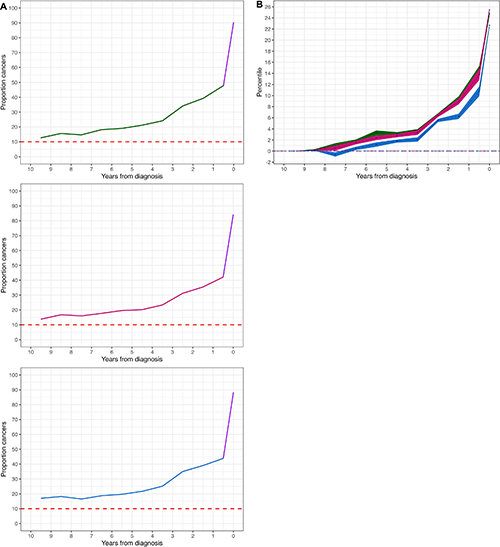
The AI-CAD systems successfully identified many of those cancers at earlier screening points, achieving 90% specificity—distinguishing between a true positive and a true negative result—in up to 19.7% of individuals 6 years before their recorded diagnosis, up to 25.2% of individuals 4 years before diagnosis and up to 39.3% 2 years before diagnosis.
AI-CAD scores could help radiologists spot early mammographic signs of potential future cancers, and a personalized approach to interpreting individual scores could help identify patients who might benefit from closer vigilance.
“This study aims to add to the growing literature regarding the application of AI in breast cancer screening and how it can help play a role in earlier detection of breast cancer,” said Dr. Strand. “Analyzing the AI scores of screened individuals over time could provide insight into how early detectable changes arise, potentially allowing for earlier intervention.”“Artificial Intelligence Detection Scores in Screening Mammography for Early Breast Cancer Alerts.” Collaborating with Dr. Strand were Sarah Hickman, M.D., Ph.D., Pantelis Gialias, M.D., Haiko Schurz, Ph.D., Fernando Cossio, B.Sc., Taeyang Choi, M.Sc., Apostolia Tsirikoglou, Ph.D., Håkan Gustafsson, Ph.D., and Sophia Zackrisson, M.D., Ph.D.
Radiology is edited by Suhny Abbara, M.D., FACR, MSCCT, Mayo Clinic, Jacksonville, Florida, and owned and published by the Radiological Society of North America, Inc. (https://pubs.rsna.org/journal/radiology)
RSNA is an association of radiologists, radiation oncologists, medical physicists and related scientists promoting excellence in patient care and health care delivery through education, research and technologic innovation. The Society is based in Oak Brook, Illinois. (RSNA.org)
For patient-friendly information on mammography, visit RadiologyInfo.org.
Images (JPG, TIF):
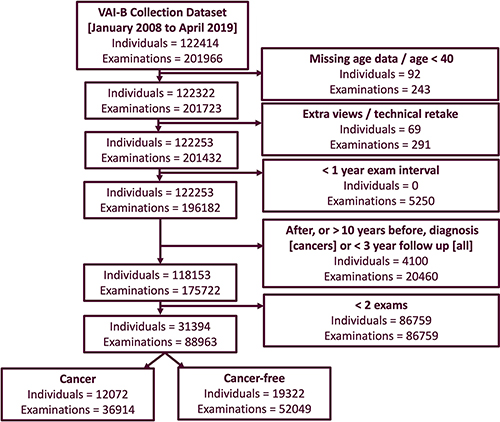
Figure 1. Standards for Reporting of Diagnostic Accuracy Studies (STARD) flow diagram of individuals and mammographic examinations included in this study. VAI-B = Validation of Artificial Intelligence for Breast Imaging.