RSNA Press Release
Ultrasound Pinpoints Vascular Complications from Cosmetic Fillers
At A Glance
CHICAGO – Ultrasound can aid in treating complications from cosmetic filler injections, according to research being presented this week at the annual meeting of the Radiological Society of North America (RSNA).
Cosmetic fillers are injectable substances used to improve the appearance of facial features by adding volume, smoothing wrinkles and enhancing contours. The most common cosmetic filler is hyaluronic acid.

Cosmetic filler procedures have been growing in popularity. According to the American Society of Plastic Surgeons, in 2024, there were more than 5.3 million hyaluronic acid filler treatments in the U.S. alone.
However, these procedures are not without risks.
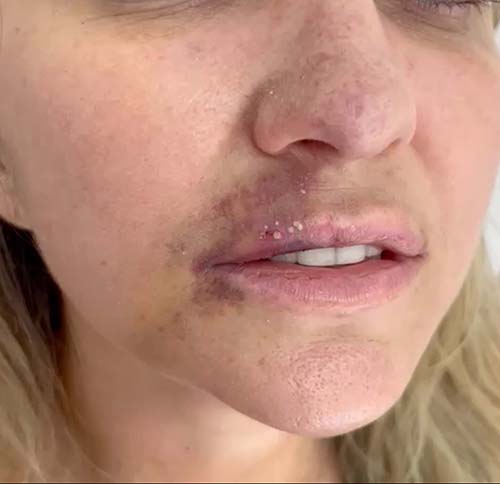
A serious complication from hyaluronic acid fillers is vascular occlusion—the disruption of blood flow in arteries—resulting from misplacement of filler material.
“Vascular occlusion events in the face can be devastating, because, if they’re not properly treated, they can cause necrosis and even facial deformation,” said study author Rosa Maria Silveira Sigrist, M.D., an attending radiologist and Ph.D. candidate at the University of São Paulo Department of Radiology in Brazil.
Dr. Sigrist’s team studied filler-related vascular complications across four radiology centers, one dermatology center and one plastic surgery center between May 2022 and April 2025, evaluating vascular ultrasound findings in 100 patients.
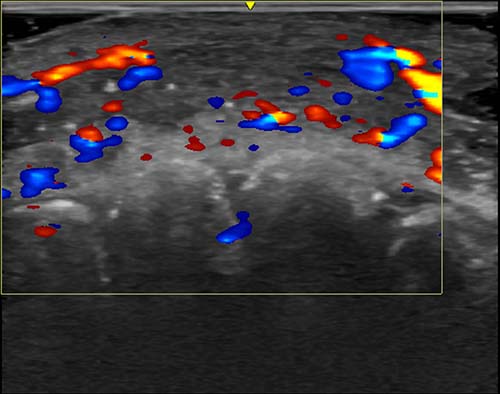
The most common finding—in 42% of cases—was absent flow to perforator vessels, which connect superficial to deep arteries in the face. In 35% of cases, flow was absent in major blood vessels, and this finding was significantly associated with lateral nasal artery involvement.
Areas around the nose are particularly risky injection sites, because nasal vessels communicate with external carotid system via the facial arteries and via the internal carotid system through the retina of the eye, Dr. Sigrist cautioned. Severe complications caused by damage to these vessels can include blindness and stroke.
To treat filler-related complications, clinicians inject hyaluronidase, an enzyme that helps break down the hyaluronic acid filler material.
“If injectors are not guided by ultrasound, they treat based on where the clinical findings are and inject blindly,” Dr. Sigrist said. “But if we can see the ultrasound finding, we can target the exact place where the occlusion occurs. Rather than flooding the area with hyaluronidase, we can do guided injections that use less hyaluronidase and provide better treatment results.”
Ultrasound is also a useful tool for guiding the filler injections themselves, increasing the injector’s precision so that less filler is needed and complications are less likely from the start, Dr. Sigrist explained.
Ultrasound criteria are well established for mapping out blood flow in areas such as the carotid vessels and the vessels of the limbs. But in the delicate, complex and highly variable vasculature of the face, radiologists need a reference standard to map out common patterns of filler-related complications. Dr. Sigrist’s team provides a framework that can help radiologists recognize these patterns, make timely decisions and treat with precision before serious damage occurs.
Co-authors are Maria Cristina Chammas, M.D., Ph.D., Ximena Wortsman, M.D., Claudia Gonzalez, M.D., Fernanda A. Cavallieri, M.D., Stella Desyatnikova, M.D., and Leonie Schelke, M.D.Note: Copies of RSNA 2025 news releases and electronic images will be available online at RSNA.org/press25.
RSNA is an association of radiologists, radiation oncologists, medical physicists and related scientists promoting excellence in patient care and health care delivery through education, research and technologic innovation. The Society is based in Oak Brook, Illinois. (RSNA.org)
Editor’s note: The data in these releases may differ from those in the published abstract and those presented at the meeting, as researchers continue to update their data right up until the meeting. To ensure you are using the most up-to-date information, please call the RSNA Newsroom at 1-312-791-6610.
For patient-friendly information on vascular ultrasound, visit RadiologyInfo.org.
Video (MP4):

Images (JPG, TIF):
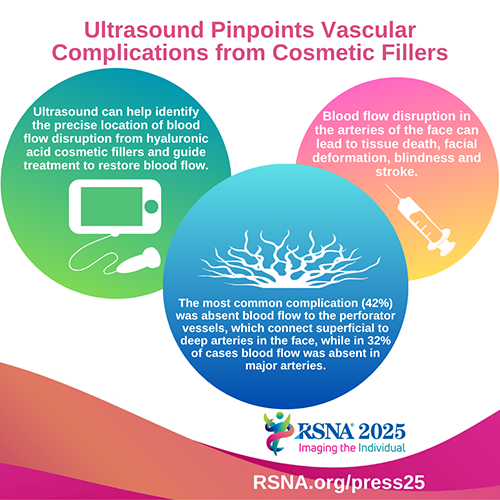
Infographic